

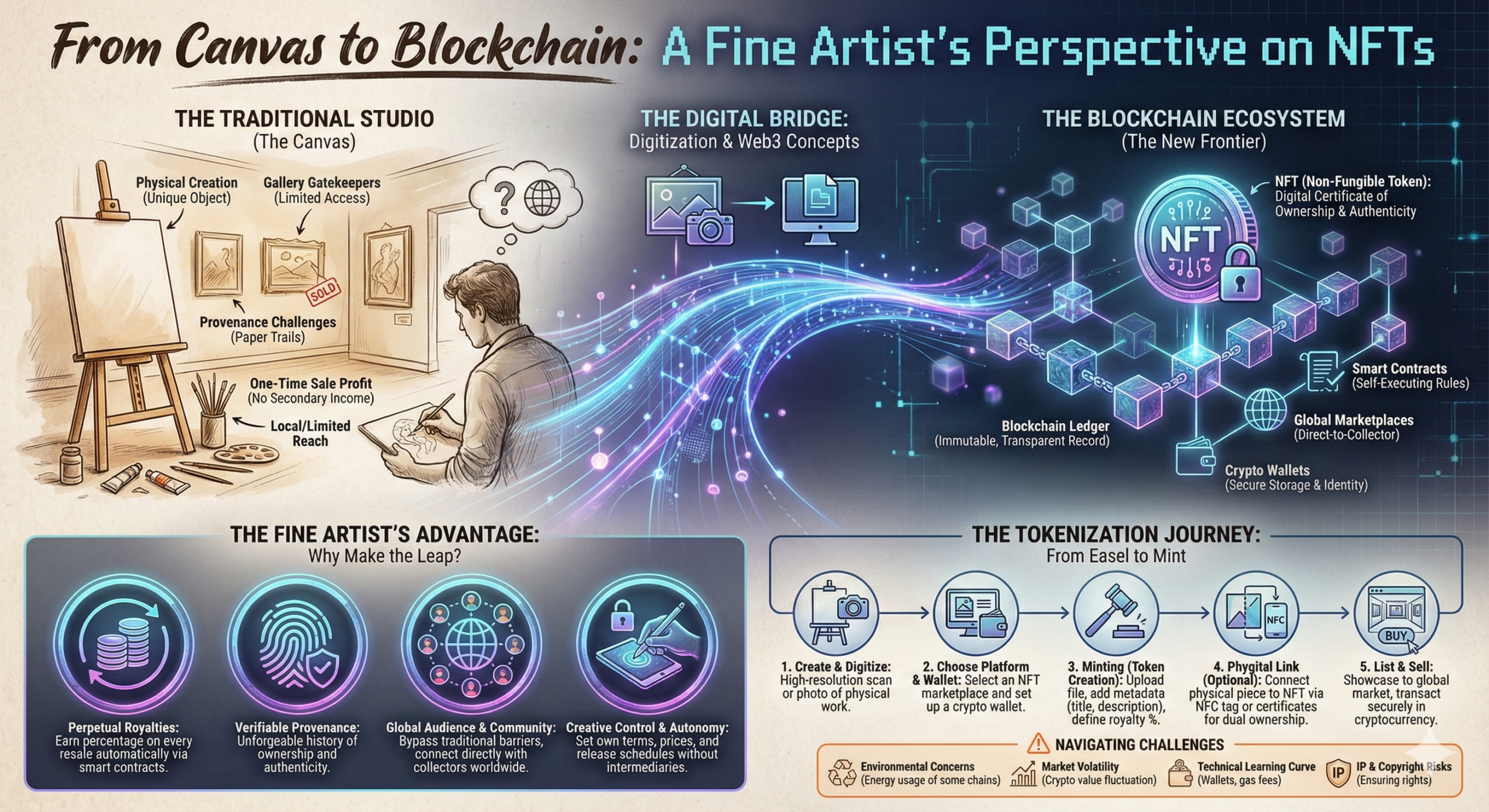
The art world stands at a fascinating crossroads. Traditional fine artists—those of us who built our practices on charcoal-stained fingers, oil-paint palettes, and the intimate relationship between hand and canvas—now face a question that would have seemed absurd a decade ago: Should we tokenize our work?
As both a classically trained fine artist and a digital strategist, I’ve watched the NFT conversation unfold with equal parts curiosity and caution. The promise is seductive: global accessibility, direct artist-to-collector relationships, royalties on secondary sales, and liberation from traditional gallery gatekeeping. But the reality is far more nuanced, especially for artists whose work originates in physical media.
Understanding the Fundamental Shift
When we talk about converting visual arts into NFTs, we’re not simply digitizing artwork—we’re fundamentally restructuring the relationship between artist, artwork, and audience. An NFT (non-fungible token) represents verified ownership and authenticity on a blockchain, creating a permanent, traceable record that can’t be duplicated or forged.
For traditional artists, this presents both opportunity and paradox. The original charcoal portrait still exists in my studio. The oil painting still hangs on a collector’s wall. What an NFT offers is something different: a certified digital representation that carries its own market value, independent of the physical piece.
The Bridge Between Traditional and Digital
The most successful transitions from visual arts to NFTs don’t simply photograph finished work and mint tokens. They require thoughtful consideration of how physical artwork translates to digital viewing contexts.
Resolution and detail matter intensely. That subtle gradation in a skin tone rendered with colored pencil and the textural depth of mixed media—these elements must survive digital translation. High-resolution scanning or photography becomes not just documentation but artistic interpretation itself.
Scale shifts dramatically. A 24×36-inch canvas viewed across a gallery has an entirely different visual impact than the same image displayed on a phone screen or computer monitor. Some artists are discovering that more minor, more intimate works actually gain power in digital contexts, where viewers can zoom into details impossible to see in physical viewing.
Color accuracy becomes critical. Earth tones and muted neutrals that celebrate natural skin tones require careful color management across digital displays. What appears warm sienna on a calibrated monitor might look very different on another screen.
The Infrastructure Question
Here’s what the NFT conversation often overlooks: minting tokens requires technical infrastructure that most fine artists don’t inherently possess. You need cryptocurrency wallets, an understanding of different blockchain platforms (Ethereum, Tezos, Polygon, etc.), knowledge of gas fees and smart contracts, and familiarity with marketplaces like OpenSea, Foundation, or SuperRare.
This creates a barrier to entry that disproportionately affects artists from communities already underrepresented in traditional art markets. The very democratization that NFTs promise can paradoxically exclude artists without technical resources or literacy.
The solution isn’t to avoid the technology—it’s to build accessible education and infrastructure that allows artists to make informed decisions about whether NFTs serve their practice and values.
Cultural Considerations for Black Artists
The stereotype-challenging work that centers Black subjects, experiences, and perspectives faces unique considerations in NFT spaces. While blockchain technology offers unprecedented control over provenance and secondary sales—addressing historical issues of Black artists being systematically undervalued and excluded from profit when their work appreciates—it also requires navigating predominantly white, tech-centered communities.
The question becomes, how do we bring work that challenges limiting stereotypes and reveals cultural depth into spaces that may not initially understand its context or value?
Some artists are finding success by building community first—creating Discord servers, hosting Twitter Spaces, and educating potential collectors about the cultural significance and artistic lineage of their work before minting. Others are strategically choosing platforms with more diverse user bases or creating their own smart contracts that embed cultural values directly into the technology.
The Environmental Debate
We can’t discuss NFTs honestly without addressing environmental impact. Earlier blockchain systems used energy-intensive “proof of work” models that consumed enormous amounts of electricity. For artists whose work addresses social consciousness and community wellbeing, this created ethical conflicts.
Newer solutions using “proof of stake” systems (like Ethereum after “The Merge”) significantly reduce energy consumption. Platforms built on Tezos or Polygon offer lower-impact alternatives. But artists must do their research and make conscious choices about which technological infrastructures align with their values.
Revenue Models and Artist Independence
The promise of perpetual royalties—receiving a percentage every time your NFT resells—represents genuinely revolutionary infrastructure for artist independence. Traditional art markets allow galleries, auction houses, and collectors to profit enormously when artwork appreciates, while the original artist receives nothing.
NFTs can embed royalty structures directly into the token, creating ongoing revenue streams. This fundamentally changes the economics of an art career, potentially providing sustainable income even for artists who make relatively few pieces.
However, royalties aren’t guaranteed. They depend on sales happening on platforms that honor them, and enforcement remains challenging across decentralized marketplaces.
Practical Strategies for Traditional Artists
If you’re considering NFTs for your visual art practice, here’s a framework grounded in demonstrated results rather than hype:
Start with education. Don’t mint until you understand what you’re actually doing. Free resources exist, but prioritize learning from people who’ve built successful practices themselves—apply that same 10K Rule you’d use for any expertise.
Consider your why. Are NFTs serving your artistic vision and business goals, or are you chasing trends? The technology should enhance your practice, not dictate it.
Maintain control of your physical work. You can create NFTs while keeping original pieces. Many artists offer both, with the NFT representing a limited digital edition.
Build community before you mint. The most successful NFT artists spend months engaging with communities, sharing their process, and educating potential collectors before launching collections.
Protect your intellectual property. Understand what rights you’re granting (or not granting) when you mint an NFT. Clear terms prevent disputes later.
The Bigger Picture
Converting visual arts into NFTs isn’t really about technology—it’s about reimagining what artist independence looks like in the 21st century. It’s about creating infrastructure that allows artists to build sustainable practices without depending entirely on traditional gatekeepers.
But technology alone doesn’t solve systemic issues. If NFT spaces replicate the exclusions and inequities of traditional art markets, we haven’t actually created meaningful change. The opportunity exists to build something better—but only if we approach it thoughtfully, with both technical competence and cultural consciousness.
For fine artists considering this transition, the question isn’t whether NFTs are universally “good” or “bad”—it’s whether this particular technology serves your specific artistic vision, business model, and values. That’s a question only you can answer, but you deserve access to the information and infrastructure needed to make that decision intentionally.
The Canvas-to-Blockchain bridge exists. Whether you choose to cross it should depend on where you’re trying to go.