
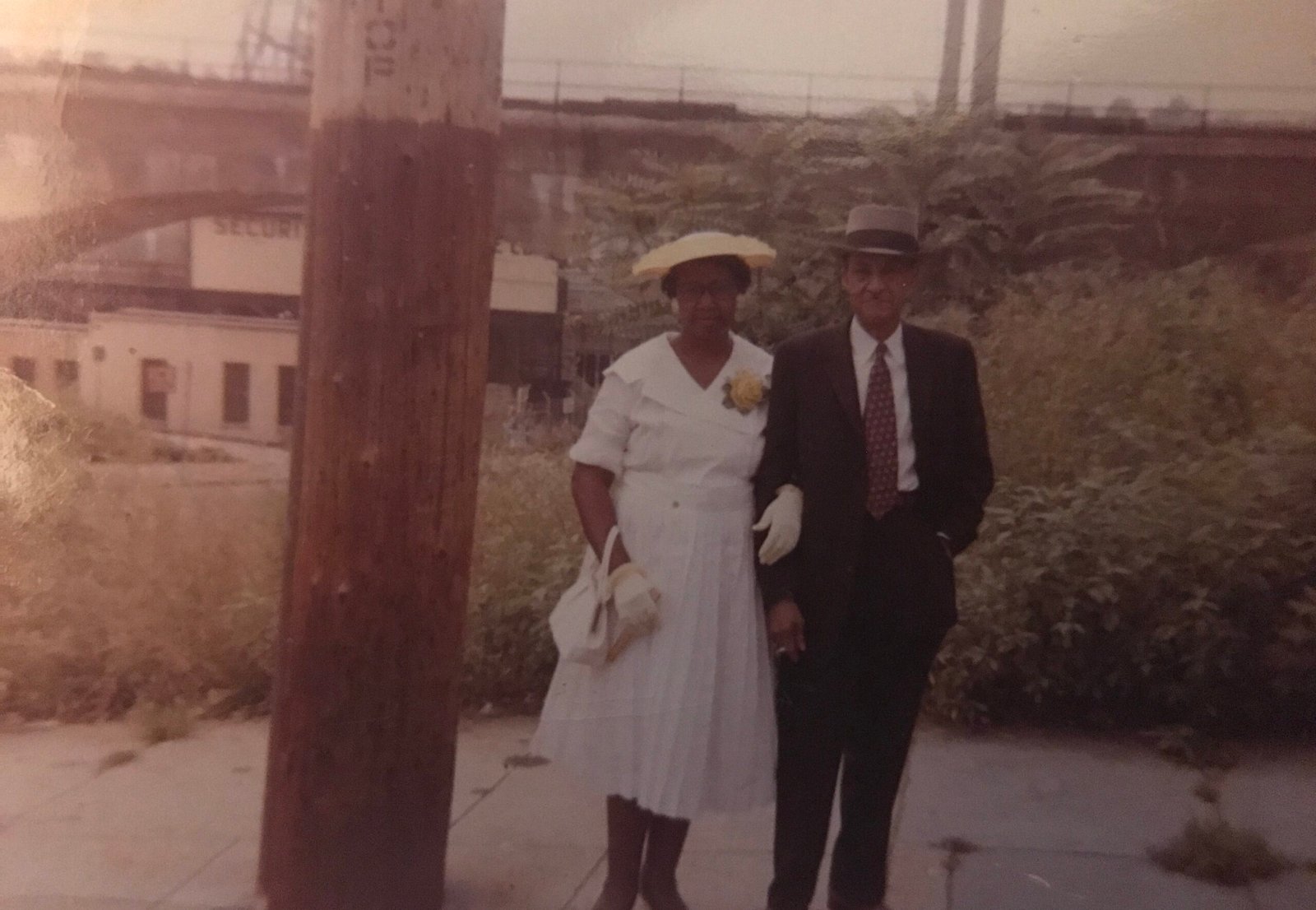
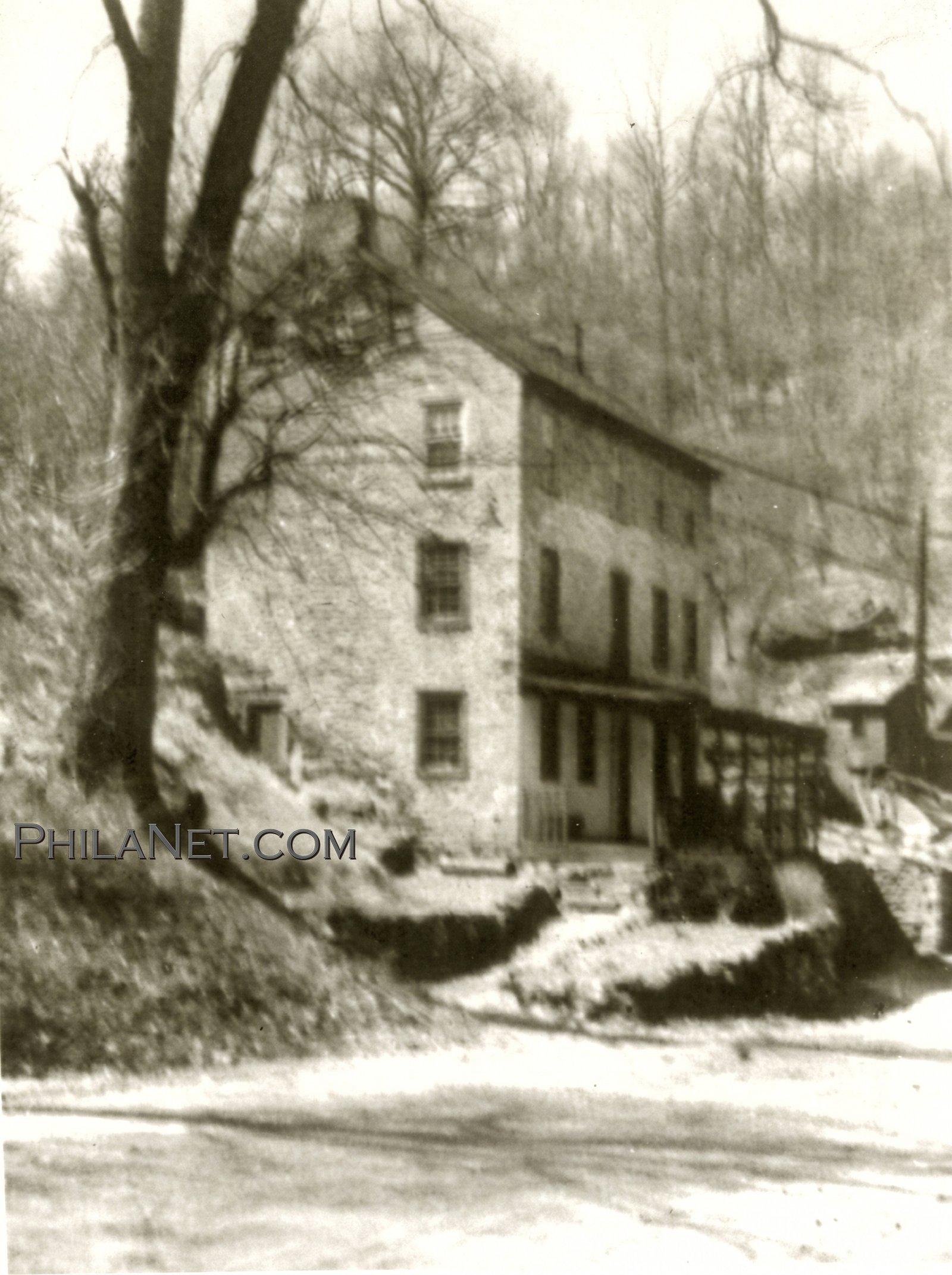
The Flat Rock Hotel was a gathering place along the Schuylkill. Farmers brought produce from upstate down Domino Lane in Manayunk and crossed the river to Belmont Hills, while canal men came to rest, share a drink, and play dominoes. Also known as the Tunnel House, it was demolished in the 1950s when the Schuylkill Expressway was built through the riverfront. Before it was lost, it was my family's home.
For years, the stone building known as the Flat Rock Hotel, also called the Tunnel House, stood along River Road in Belmont Hills/West Manayunk, on the west bank of the Schuylkill River opposite Manayunk. Local histories describe it as a gathering place for farmers who brought produce down Domino Lane in Manayunk, crossed the river, and came to Belmont Hills to trade, drink, and play dominoes with canal workers. The hotel sat in a narrow strip of land between the river, the canal and railroad, and what would later become the Schuylkill Expressway.
The community itself has carried several names. The Lower Merion Historical Society’s history of Belmont Hills records that the village on the west bank was originally called Rocky Hill and became known as West Manayunk when the Reading Railroad was built in 1838. The current name came by popular vote. In October 1953, the West Manayunk Civic Association distributed ballots asking residents whether to keep the old name or adopt a new one, a referendum spurred in part by an unflattering description of West Manayunk in a 1950 Holiday Magazine article by author James Michener. Of 896 votes cast, 627 favored a new name, and 475 of those chose Belmont Hills. This means that when my family was recorded at 6 River Road in the 1950 census, the neighborhood around them was still called West Manayunk, and they lived through the very years in which both the village name and the riverfront itself were transformed.
Today, Flat Rock Park occupies this same riverfront corridor, a 24.3-acre nature park at 122 River Road, Gladwyne, PA 19035, bordered on one side by the Schuylkill and on the other by River Road. Township documents call the park a hidden gem along the river, with walking paths, landscaping, and a boat launch where canal commerce and river labor once defined daily life. Historical notes from the Lower Merion Historical Society record that the Flat Rock Hotel/Tunnel House was demolished in the 1950s when the Schuylkill Expressway was built through this corridor, erasing several mill type residences and inns that lined the river.
Roots in South Carolina
My great-grandfather, Booker T. Kennedy, later known as Booker T. Robinson, was born on January 16, 1905, in Abbeville County, South Carolina. He was biracial, born to Louis Kennedy and Willie Mae Robinson. Ancestry records trace his early years in Cedar Springs and Magnolia, Abbeville County, where he appears in census records first as a grandson, then as a son, and by 1930 as a married head of household raising his own children.
It was after the family reached Pennsylvania that the name changed. Booker took the surname Robinson, the name carried by his half-siblings. The children born before the move, in South Carolina and Virginia, had Kennedy on their birth certificates, while every child born in Pennsylvania was named Robinson from birth. This is why my family appears in Southern records as Kennedy and in Pennsylvania records as Robinson. One family, one bloodline, carried under two names across three states.
The Journey North
Booker and his wife Leolia did not make the journey north all at once. Like so many African American families of the Great Migration, they traveled in stages, carrying their growing family with them. When they left South Carolina, they traveled with their children Johnny, Willie T, Elizabeth (Bessie), Rosella, and Rachel. Along the way, the family grew again. The twins, Geraldine and Justine, were born on March 28, 1937, in Orange County, Virginia, a waypoint on the road between Abbeville County and Philadelphia.
By 1938, the family had reached Philadelphia and was living at 4232 Main Street in the Manayunk section of the city. That year brought heartbreak. Leolia, pregnant at the time, delivered a stillborn son on September 13, 1938. Booker’s extended family lived close by on the 4600 block of Canton Street, just a few blocks away, so even in grief the family was surrounded by its own.
From Manayunk, the family then moved across the river to 6 River Road in Lower Merion.
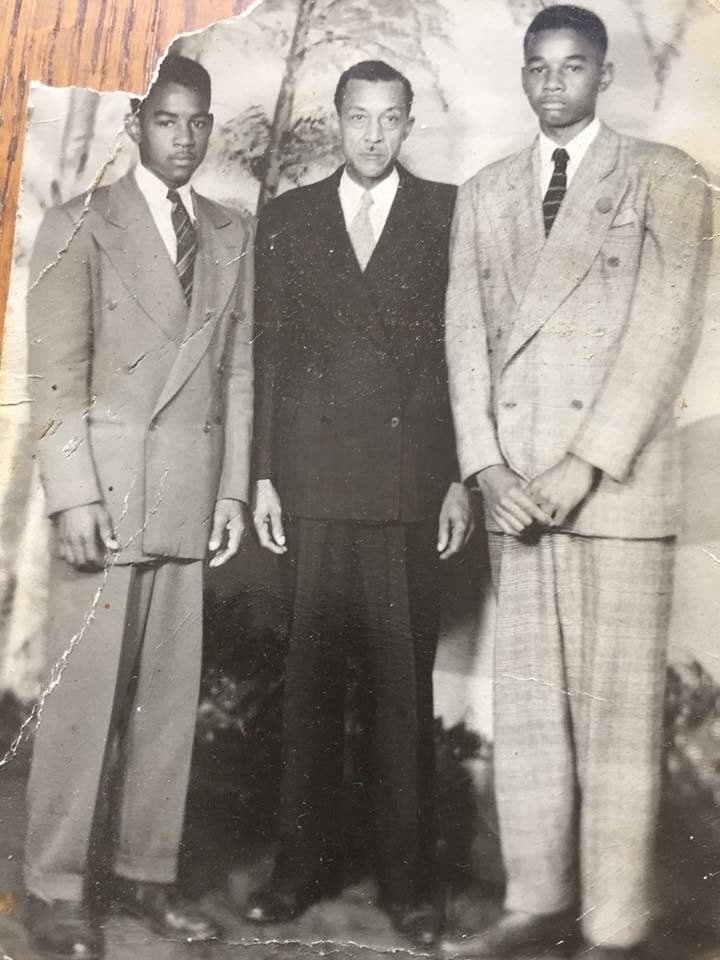
Left to right: son, John Robinson, father, Booker T. Robinson, and son, Willie T. Robinson
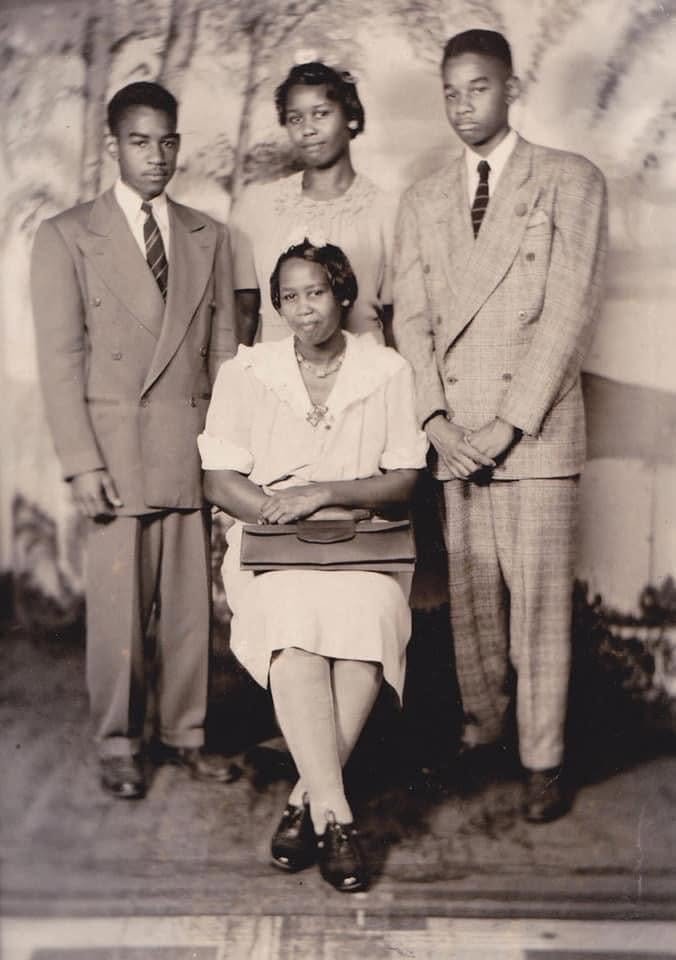
Left to right: son, John Robinson, sister, Mary Ramey-Barksdale, son Willie T. Robinson, and centered, Mother, Leolia Robinson (Sr)
Living in the Flat Rock House
The 1950 United States Federal Census places my great-grandfather firmly on River Road. In the census image and the Ancestry source citation, he appears as Booker Robinson, age 47, head of household, with the residence recorded as Lower Merion, Montgomery, Pennsylvania, street name River Road, house number 6, dwelling number 75, occupation laborer. The household listed his wife Leona (Leolia); daughters Elizabeth, Rose A. (Rosella), and Rachael; the twins Geraldine and Justine; son Walter J.; and daughters Dolores, Lela M., and Leona (Leolia Jr.). Like many census records of that era, the enumerator did not always capture the proper spellings of the family’s names, which is why Leolia appears as Leona, Rosella as Rose A., and Rachel as Rachael. These small errors are common in historical records of African American families and do not change who the record describes.
According to my grandmother, the late Dolores Robinson Dennis, our family did not simply live somewhere along River Road. They lived in the old Flat Rock Hotel house itself. She remembered from childhood that the house had many rooms, as an old hotel would, and that when it rained the children’s toys would wash away, a vivid detail of life pressed close against the river and the low ground of the canal corridor. Her memory aligns with the known history of the building. The hotel was a multi-story stone structure that had served farmers and canal men, and by the mid-twentieth century, such buildings often became worker housing for laborers employed in nearby mills, railroads, and construction. Booker’s occupation as a laborer and the family’s address at 6 River Road fit naturally into this pattern. While the family lived on River Road, the children were educated at the Lower Merion elementary school, walking the same hillside streets as the children of the mill and quarry families around them.
When the Schuylkill Expressway (I-76) was planned and constructed in the 1950s, engineers drove the highway along this narrow riverfront, requiring the demolition of older structures including the Flat Rock Hotel. Construction of the expressway began in 1949, and the section running from Conshohocken past this stretch of riverfront to City Avenue opened to traffic on September 1, 1954. This timeline places the loss of the Flat Rock house within roughly four years of the 1950 census that recorded my family living inside it. Township planning documents refer to sections of old River Road and related mill type residences being vacated and removed as part of expressway and riverfront changes, matching the story my grandmother passed down about the house ultimately being lost to highway construction. The Historical Society’s own account of Belmont Hills notes that the Flat Rock Hotel was demolished when the expressway was built in the 1950s and that the row houses of Rudolph’s Row, rented by paper mill workers along the riverbank, were torn down in those same years for the same highway. The place where my great-grandfather raised his family became one of the many ordinary homes swept away by mid-century infrastructure projects, part of an entire working-class riverfront that vanished within a single decade.
A Church Family: From Umbria Street to New Umbria
Faith anchored the family through every move. The Robinsons were members of Umbria Baptist Church at 4616 Umbria Street, whose first baptism services were held at the Galilee Baptist Church in Roxborough.
In 1955, Rev. Donald E. Alexander became pastor of the church. Under his leadership the members agreed to change the name of Umbria Baptist Church to the historic New Umbria Baptist Church, a decision made in contemplation of a move to a new location. Rev. Alexander’s ministry was instrumental in relocating the church to 4147-49 Main Street in Manayunk. He interceded in purchasing all of the properties, 4147-49 Main Street and the apartment building at 4143-45 Main Street, at a total cost of $58,700.
On September 30, 1962, the members marched from 4616 Umbria Street to the new edifice of New Umbria Baptist Church. With the choir singing and the congregation following, the dedication service was held before entering.
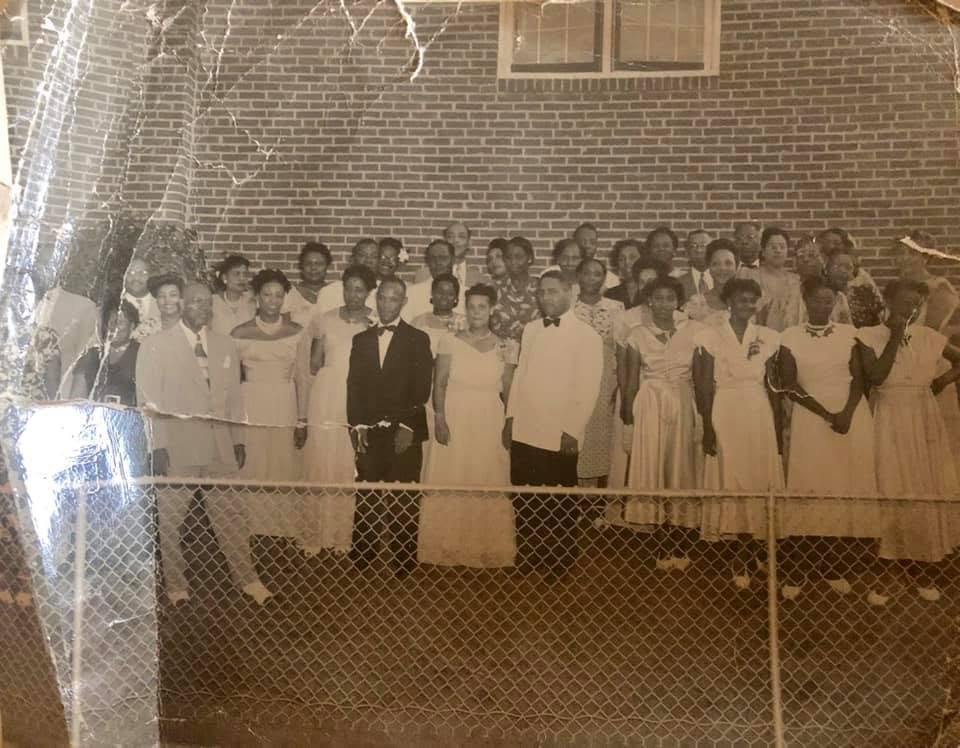
4616 Umbria Street - Umbria Baptist Church, now renamed to New Umbria Baptist Church, 4147-49 Main Street, Philadelphia, PA.
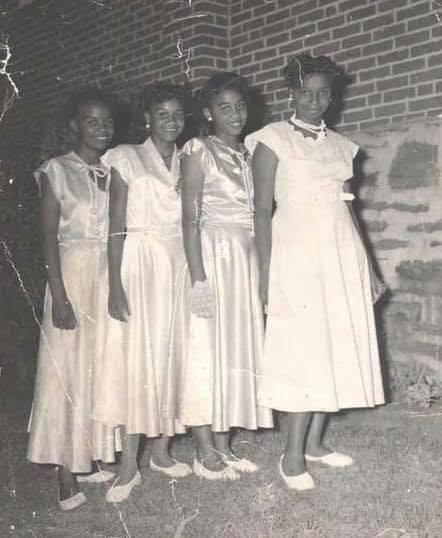
Left to right: Photo: Rachel, Elizabeth, Rosella, and Alberta Paul
Both Booker and Leolia were active in the church, and their daughters filled it with music across generations. Rachel, Elizabeth, and Rosella sang in a choir alongside church member Alberta Paul. The younger daughters, Dolores, Lela, and Leolia Jr., formed the New Umbria House Wreckers. Later still, their children carried the tradition forward in a group named Family United, whose members were the late Sidney Taylor, Sharmane Whitfield, Germaine Robinson, and Michelle Taylor-Bradley, with Vincent Weldon at the piano. Generation after generation of one family, singing in one church, on the same Main Street where the family had first landed in Philadelphia decades before.
Silverwood Street and Final Resting Places
After the move from River Road, Booker and Leolia resided on the 4400 block of Silverwood Street in Manayunk, where they remained until their deaths. Booker passed on December 14, 1981, in Philadelphia and was laid to rest on December 19, 1981. Leolia followed him in December 1982. Both are buried at Westminster Cemetery in Bala Cynwyd, just off Belmont Hills. Westminster, which has operated as a non-denominational cemetery since 1894, spans more than one hundred acres of rolling ground overlooking the Schuylkill River and the hamlets of Manayunk and Roxborough. It is a fitting resting place. From that hillside, Booker and Leolia lie within view of the same river valley where they raised their family, the Manayunk streets where they first settled, and the west bank where the Flat Rock house once stood.
Other members of the family are buried at Merion Memorial Park on West Rock Hill Road in Bala Cynwyd, a cemetery with its own deep place in African American history. Established more than a century ago as a burial ground open to people of all races and religions at a time when many cemeteries were segregated, Merion Memorial Park became the resting place of many prominent Black Philadelphians. Its eight sections are named for figures of nineteenth-century abolitionism and civil rights, including Banneker, Catto, Lincoln, and Sumner, and it holds the graves of James A. Bland, the composer honored with a Pennsylvania state historical marker at the cemetery entrance, and blues musician Skip James. That members of my family rest in this ground ties them once more to the larger story of African American life, dignity, and memory in Lower Merion.
From Hidden River to Family Memory
Flat Rock Park today is described as one of Lower Merion’s best-kept secrets, a quiet riverfront park where residents enjoy walking paths, picnics, and access to the Schuylkill. For my family, this landscape is not only a scenic retreat. It is the ground where Booker T. Kennedy/Robinson and his children lived and worked, where Southern migrants forged new lives along a hidden river in Montgomery County. Standing near Flat Rock Park, I can imagine my great-grandfather and my grandmother in that stone building with its many rooms, watching the rain carry toys toward the same water that once carried canal boats and now reflects highway bridges and rowing shells.
By bringing together local historical sources on the Flat Rock Hotel/Tunnel House, modern descriptions of Flat Rock Park, documentary evidence from the 1950 census and Ancestry records, and the living memory of Dolores Robinson Dennis, this narrative situates my family’s story within the broader history of Lower Merion’s riverfront. The Historical Society’s account of Belmont Hills tells the story of Welsh, English, German, Irish, Italian, and Albanian settlers who built this hillside village over three centuries. My family’s presence at 6 River Road adds another chapter to that story, the chapter of African American families of the Great Migration who also made this west bank their home, worked as laborers along its river, and raised their children within sight of its mills and canal. It traces a single family from Abbeville County, South Carolina, through Orange County, Virginia, to Main Street in Manayunk, to 6 River Road on the west bank of the Schuylkill, to New Umbria Baptist Church, and finally to Silverwood Street. It shows how one address links the Great Migration, the Schuylkill Canal, the Reading Railroad’s Flat Rock Tunnel, and the transformation of a river corridor into park and expressway, preserving the memory of the people who called the Flat Rock house home even after the building itself disappeared.
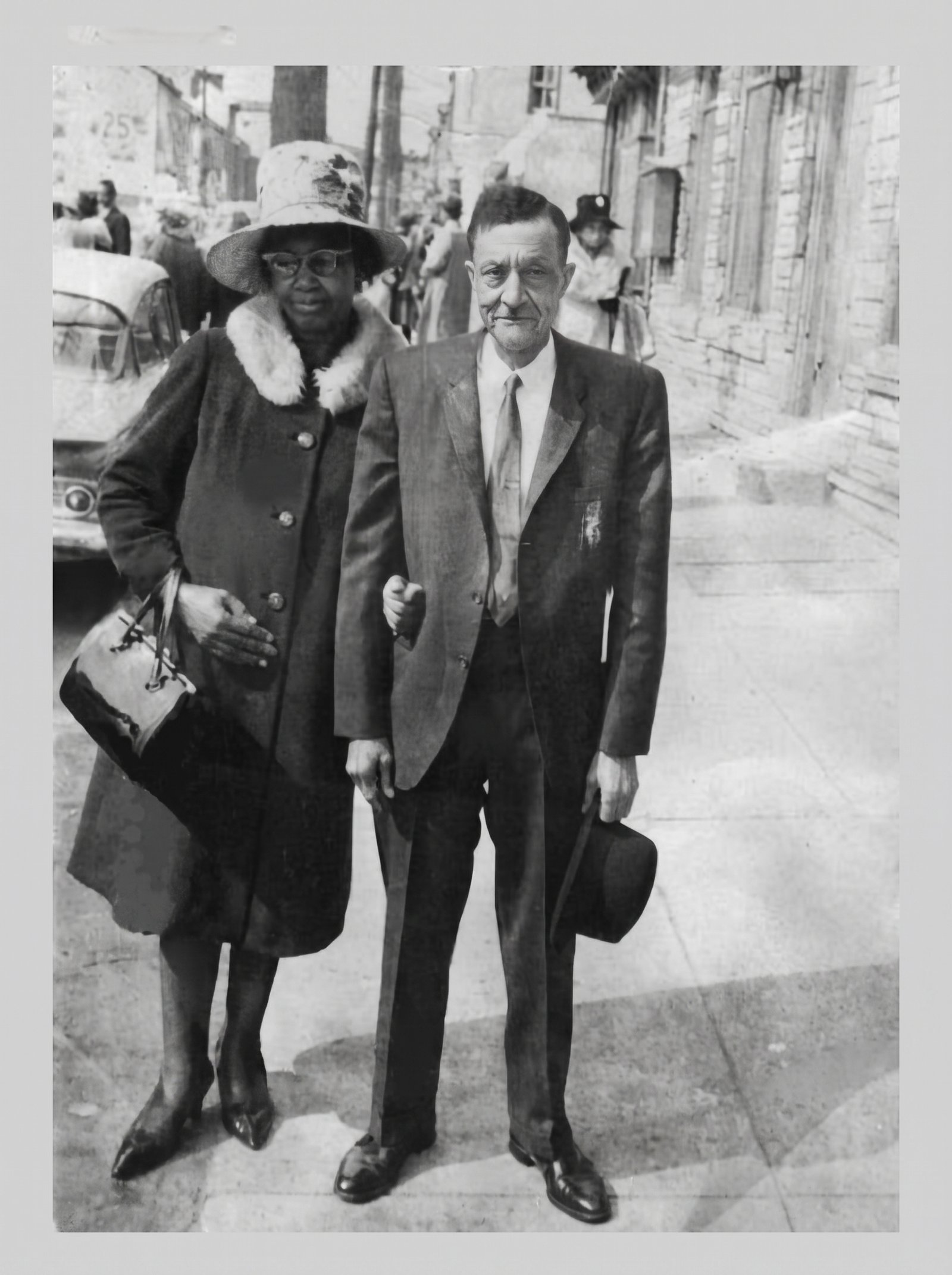
Left to right: Leolia and Booker T. Robinson standing outside of the New Umbria Baptist Church. Original photograph, AI-restored.
Sources
- 1950 United States Federal Census, Lower Merion Township, Montgomery County, Pennsylvania, Enumeration District 46-189, Sheet 9, enumerated May 9, 1950. Household of Booker Robinson, River Road, house number 6, dwelling number 75.
- com, family tree profile, and source citations for Booker T. Kennedy (Robinson), 1905-1981, including the 1910, 1920, 1930, and 1950 federal censuses, Pennsylvania death certificates, South Carolina death records, and Social Security records.
- Lower Merion Historical Society, The First 300, “Belmont Hills,” collections.lowermerionhistory.org, including the photograph and caption for the Flat Rock Hotel/Tunnel House and the account of Rudolph’s Row.
- Main Line Times and Main Line Today retrospective accounts of the October 1953 West Manayunk Civic Association naming referendum and the 1950 Holiday Magazine article by James Michener.
- Historical accounts of the Schuylkill Expressway (Interstate 76), including construction beginning in 1949 and the opening of the Conshohocken to City Avenue section on September 1, 1954.
- Westminster Cemetery, Bala Cynwyd, Pennsylvania, operating as a non-denominational cemetery since 1894.
- Merion Memorial Park, Bala Cynwyd, Pennsylvania, cemetery history, and the Pennsylvania Historical and Museum Commission marker for James A. Bland at the cemetery entrance.
- Congregational history of New Umbria Baptist Church, formerly Umbria Baptist Church, 4616 Umbria Street and 4147-49 Main Street, Philadelphia.
- Family oral history as told by the late Dolores Robinson Dennis and preserved by her descendant, Arrita S. N. Robinson.