
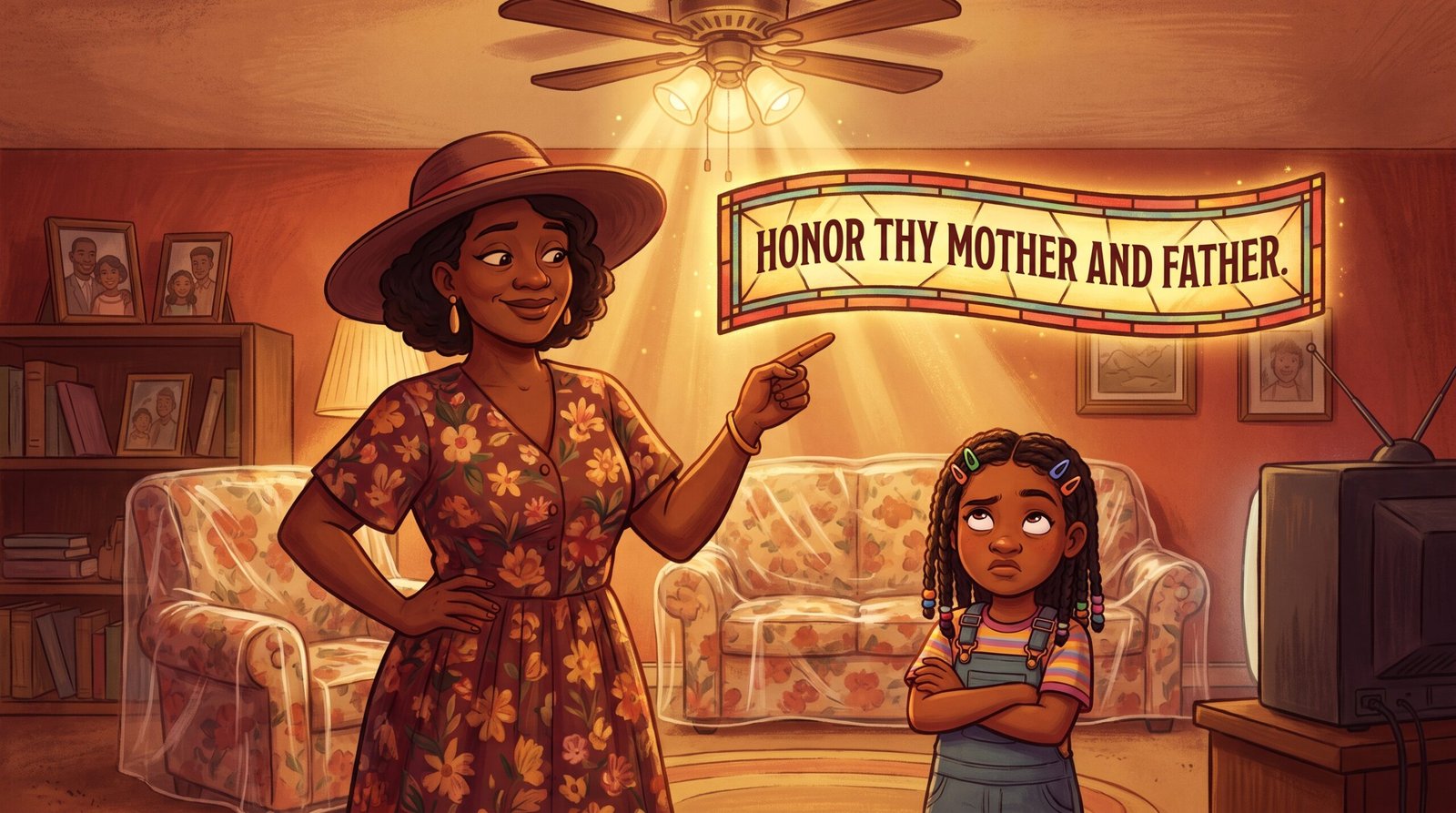
If you grew up in a Black church household, you already know where this is going.
Picture it. My mother has just finished chastising me. I am standing there with my lips pressed together, and my face is doing that thing where it says everything my mouth knows better than to say. Before a single word could escape, she would look at me and declare, “Honor thy mother and father.” That was it. Case closed. Court adjourned. God Himself had apparently co-signed her side of the argument.
It was her favorite scripture, and honestly, it worked. I laugh about it now because I know her heart. My mother used that verse the way a parent uses a seatbelt to hold me in place long enough to keep me safe. There was love underneath it.
But as I have grown and listened to other people’s stories, I have learned something sobering. Not every parent quotes that verse from a place of love. Some use it as a muzzle. Some use it as a shield. Some use it to escape accountability for the very harm they caused. And when a child, or even an adult child, dares to name a parent’s hypocrisy, the verse gets thrown like a stone: “You’re dishonoring me. The Bible says, “Honor thy mother and father.”
So let’s talk about what this scripture actually says and what it never said.
What the Verse Actually Means
“Honor your father and your mother, so that your days may be long in the land the Lord your God is giving you.” (Exodus 20:12)
The Hebrew word for “honor” is “kabed.” It means weight, substance, and glory. To honor your parents is to treat them as people of significance, whose words and needs carry real weight in your life. It shows up again in Deuteronomy 5:16 and is repeated in the New Testament, where Paul calls it “the first commandment with a promise” (Ephesians 6:2).
Notice what the word does not mean. It does not mean silence. It does not mean pretending. It does not mean unconditional obedience to whatever a parent demands, no matter how wrong. Honor is a posture of respect and practical care. It was written to a people whose survival depended on generations caring for one another, especially aging parents who could no longer care for themselves.
Honor is beautiful. Honor is holy. And honor was never designed to be a weapon.
When Honor Becomes a Weapon
Here is where we have to be honest, church.
Some parents have taken this verse and turned it into a tool of control. When a child says, “You hurt me,” the response is not repentance. It is “honor thy mother and father.” When an adult child sets a boundary, the response is not reflection. It is “you’re being disrespectful, and God is going to deal with you.”
That is not honor. That is manipulation wearing a choir robe.
Scripture wielded to silence the wounded is Scripture being abused. When “honor” is redefined as “never question me, never correct me, never hold me responsible,” the covenant ethic of the commandment gets twisted into authoritarianism. And Jesus had something to say about that.
In Mark 7:9-13, Jesus confronted religious leaders who used a spiritual loophole called Corban to avoid caring for their own parents. They had religious language on their lips and neglect in their hands. Jesus called it what it was: nullifying the word of God for the sake of tradition. Hear that clearly. Jesus Himself confronted people who misused this very commandment. If He held religious adults accountable for hiding behind spiritual talk, He is not impressed when parents do the same thing to their children.
What the Bible Requires of Parents
The fifth commandment does not stand alone. Scripture places heavy, specific obligations on parents too, and it does not mince words.
Parents are commanded not to provoke their children. “Fathers, do not provoke your children to anger, but bring them up in the discipline and instruction of the Lord” (Ephesians 6:4). Paul says it again in Colossians 3:21: “Fathers, do not embitter your children, or they will become discouraged.” Constant criticism, humiliation, unpredictable rage, favoritism, and demands for perfection are not parenting. They are provocation, and God forbids them.
Parents are accountable for the harm they cause. In 1 Samuel 2-3, the priest Eli knew his sons were doing evil and refused to restrain them. God did not excuse Eli because of his title or his position. God held him responsible. Position does not cancel accountability. Not in the temple, and not in the living room.
God does not transfer a parent’s guilt onto the child. Ezekiel 18 is one of the clearest chapters in the Bible on this. “The one who sins is the one who will die. The child will not share the guilt of the parent, nor will the parent share the guilt of the child” (Ezekiel 18:20). Each soul answers for its own actions. A parent cannot blame their child, their circumstances, or anyone else for choices they made. And a child does not carry the blame for a parent’s sin, no matter how many times they were told otherwise.
God defends children; He does not sacrifice them. Jesus said that whoever causes one of these little ones to stumble, it would be better for them to have a millstone hung around their neck and be drowned in the depths of the sea (Matthew 18:6). That is not gentle language. God takes the exploitation of the vulnerable personally.
So when a parent harms a child and then blames the child for speaking up, that parent is not standing on Exodus 20:12. They are standing on nothing. The same Bible that says “honor your father and mother” also says parents must not provoke, must not embitter, must not cause little ones to stumble, and cannot pass their guilt to someone else. The commandment was always a two-way covenant, not a one-way street.
Honor Without Manipulation
So what does real honor look like, especially when the relationship is complicated?
Honor tells the truth. Biblical honor cannot be built on lies, so naming what happened is not dishonor. It is the beginning of healing.
Honor can hold boundaries. Peter and the apostles said, “We must obey God rather than men” (Acts 5:29). All human authority, including parental authority, sits underneath God’s authority. You can respect the role while refusing to submit to harm.
Honor is a posture, not a performance. It is refusing bitterness, refusing revenge, and refusing to repeat the cycle. Sometimes honor is caring for a parent in their old age. Sometimes honor is praying for a parent from a safe distance. Both can be holy.
And honor moves forward. The most powerful way some of us will ever honor the commandment is by breaking the pattern, by becoming the safe parent, mentor, or spiritual mother that somebody else needed and never had.
A Word to Both Sides of the Table
If you are a parent, your children’s honor is not owed to your ego. It grows in the soil of your integrity. Repentance is not weakness. Saying “I was wrong, forgive me” will do more to secure your honor than a thousand quoted verses ever could.
If you are the child who was silenced: God saw. The verse your parent used against you was never meant to protect their behavior. It was meant to build a family where love, justice, and truth live together. You are allowed to tell the truth. You are allowed to heal. And you can honor God fully while doing both.
As for me, I still smile when I think about my mother and her favorite scripture. She quoted it with love, and I knew it. That is the whole difference, isn’t it? The same verse, in the hands of love, builds a child up. In the hands of control, it tears a child down.
The commandment has not changed. May we handle it the way God wrote it.
Reflection
Lord, teach us to honor with clean hands. Where we are parents, make us worthy of the weight our children give us. Where we are children, heal what was broken and free us from every false guilt that was never ours to carry. Let honor in our families look like truth, safety, repentance, and love. In Jesus’ name, Amen.
Scriptures referenced: Exodus 20:12; Deuteronomy 5:16; Ephesians 6:2-4; Colossians 3:21; Mark 7:9-13; 1 Samuel 2-3; Ezekiel 18:20; Matthew 18:6; Acts 5:29